She mentioned that her stomach felt a little funny.
Or maybe you noticed her moods shifting in ways they didn’t before. Or she came home from school quieter than usual, and something in the way she held herself told you that something was changing.
You might not be able to name it yet. But your instincts are telling you: it’s getting close.
If you’re wondering whether your daughter’s first period is on its way — here’s what to look for, what it means, and most importantly, how to make sure she feels ready when it happens.
HOW LONG BEFORE A FIRST PERIOD DO SIGNS APPEAR?
Most girls experience signs of an approaching first period for months — sometimes even a year or two — before it actually arrives.
Puberty doesn’t happen in a single moment. It unfolds in stages, and the body gives plenty of signals along the way. Learning to recognize those signals isn’t just useful for you as a parent — it’s genuinely empowering for your daughter.
A girl who understands what her body is telling her is a girl who feels in control. And feeling in control makes all the difference.
SIGN #1 — BREAST DEVELOPMENT STARTED 2-3 YEARS AGO
The most reliable predictor of a first period is when breast development began.
On average, girls get their first period about two to three years after their breasts start developing — usually starting as a small, tender area under the nipple called a breast bud.
So if your daughter started developing at 9, her first period might arrive around 11 or 12. If development started at 11, she may be looking at 13 or 14.
This isn’t a perfect formula — every body is different. But it gives you a rough timeline to work with. And more importantly, it gives you a window to have the conversation before it becomes urgent.
SIGN #2 — VAGINAL DISCHARGE HAS APPEARED
This is one of the signs most parents don’t know to look for — and one that girls often find confusing or alarming if they haven’t been told about it.
Vaginal discharge is a clear or slightly white fluid that appears in a girl’s underwear. It’s completely normal and healthy — the body’s way of keeping things clean and balanced.
What makes it significant is timing: most girls notice discharge about six to twelve months before their first period arrives.
If your daughter has mentioned it — or if you’ve noticed it in her laundry — that’s a meaningful signal. And it’s a perfect opening for a calm, matter-of-fact conversation.
“You might have noticed something in your underwear lately. That’s called discharge, and it’s totally normal. It’s actually one of the signs that your first period might be coming in the next few months.”
That’s it. No drama. Just information. And it means the world to a girl who was quietly wondering if something was wrong.
SIGN #3 — PUBIC AND UNDERARM HAIR IS GROWING
The appearance of pubic and underarm hair is another sign that puberty — and a first period — is on the way.
Hair growth typically begins in the pubic area first, then underarms. By the time a girl has noticeable hair in both areas, she is usually getting closer to her first period.
This is also often the time when body odor changes — which means deodorant becomes a practical necessity, not just a nice-to-have. If you haven’t already introduced this to your daughter, now is a good moment.
A small gesture — leaving a deodorant on her bathroom shelf without making a big deal of it — can feel like a private acknowledgment that you see what’s happening. That you’re paying attention.
Girls notice those quiet gestures. They mean more than you might think.
SIGN #4 — SHE’S BEEN GROWING QUICKLY
A significant growth spurt — usually two to three inches in a year — often happens in the year or two before a first period.
After the first period arrives, most girls slow down considerably in height. So if your daughter has been shooting up lately, it may be a sign that her body is in the final stages of preparation.
This is also the time when her body shape may be changing — hips widening, waist becoming more defined. These changes are driven by estrogen, the same hormone that is building toward her first period.
If she’s noticed and seems uncomfortable or self-conscious, a simple acknowledgment goes a long way: “Your body is changing and that can feel weird. It’s supposed to feel weird — it’s new. But everything that’s happening is exactly right.”
SIGN #5 — MOOD AND ENERGY SHIFTS ARE MORE NOTICEABLE
In the weeks and days before a first period, many girls experience emotional and physical changes that feel different from their baseline.
She might feel more tired than usual. More sensitive. More easily overwhelmed by things that didn’t bother her before. She might have lower back pain or a feeling of heaviness in her lower abdomen — a kind of dull ache that she can’t quite explain.
These are signs that hormone levels are shifting — specifically, that progesterone and estrogen are fluctuating as her body prepares to begin a cycle.
She may not connect these feelings to her period. She may just feel off and not know why.
Naming it for her — gently and without alarm — is a gift: “Sometimes in the days before a first period, girls feel a bit more emotional or tired than usual. If you ever feel that way and aren’t sure why, it might just be your body getting ready.”
WHAT TO DO ONCE YOU RECOGNIZE THE SIGNS
Knowing the signs is only half of it. The other half is making sure your daughter is actually prepared — not just aware.
Here’s what preparation looks like in practice:
Have the conversation before it happens. Not a big, formal talk — just small, calm moments where you normalize what’s coming. Car rides. Bedtime. A quiet evening at home.
Make sure she knows what to do in the moment. Where are the pads? What does she say if it happens at school? Who does she go to? Having a plan — even a simple one — transforms panic into action.
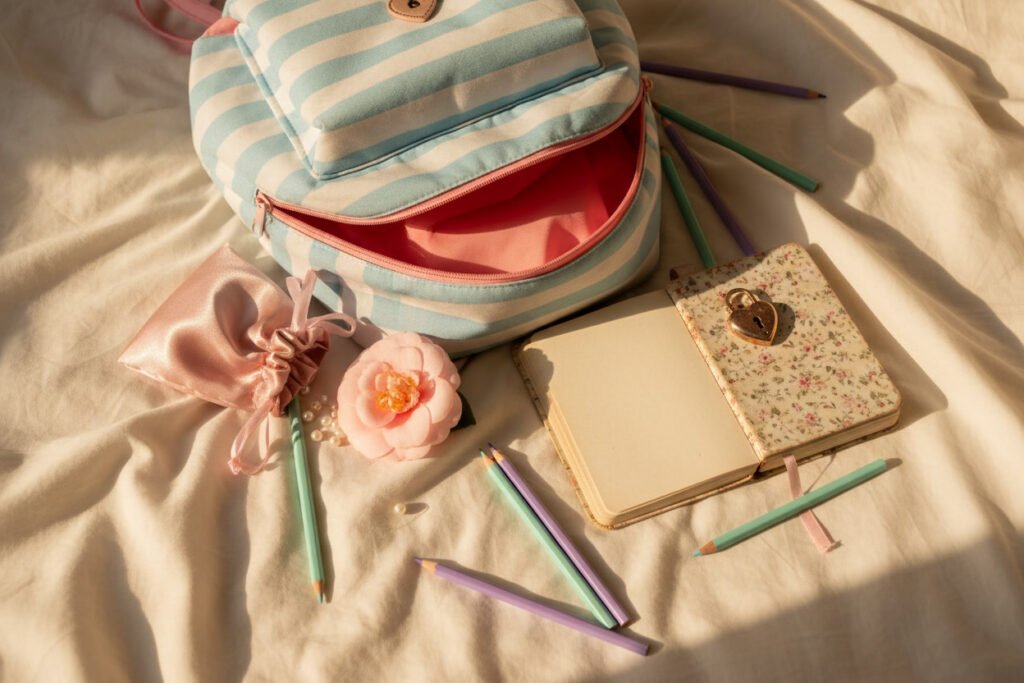
Put supplies somewhere she can find them. A small pouch in her school bag. Pads under the bathroom sink. Not as a big announcement — just quietly, so they’re there when she needs them.
Let her know it’s okay not to feel excited. Some girls are relieved. Some feel proud. Some feel annoyed, or scared, or nothing much at all. Every reaction is valid — and she doesn’t need to perform an emotion she doesn’t feel.
Keep the door open. The most important thing you can offer isn’t information — it’s availability. She needs to know that she can come to you. That you won’t make it weird. That you’ve got her.
THE QUESTION SHE’S PROBABLY NOT ASKING OUT LOUD
Here’s something most girls won’t say directly, but feel deeply:
“Will I be okay?”
Not medically. She’s probably not worried about that. What she wants to know is whether she’ll handle it — whether she’ll know what to do, whether anyone will find out, whether it will be as bad as she imagined.
The answer, of course, is yes. She will be okay. She will handle it. Girls have been handling this for as long as there have been girls — and almost every single one of them got through it, often with far less preparation than your daughter has.
But she needs to hear it from you.
So tell her. Not once, but in the small, repeated ways that add up over time.
“You’re going to be completely fine.”
“You know what to do.”
“And if you’re not sure — I’m always here.”
WANT TO MAKE THIS CONVERSATION EASIER?
I put together a free Parent Conversation Guide with exactly this in mind. It gives you simple, practical language for talking to your daughter about what’s coming — what to say, what to avoid, and how to keep the conversation going even when she seems uninterested.
It’s completely free. Download it below.
AND IF SHE WANTS SOMETHING FOR HERSELF
If your daughter would feel more confident going into this with her own guide — something she can read at her own pace, in her own space — Gentle First Period was written exactly for her.
It walks her through everything: what to expect, what to do, how to handle it if it happens at school or a friend’s house. With real scenarios she can practice in her head before they happen — so when the moment comes, she already knows she can do this.
Available on Amazon.
SHE’S MORE READY THAN SHE THINKS
The signs are there. The conversation can happen. The supplies can be ready.
And the most important thing — the thing that will stay with her long after the first period is just a memory — is knowing that when it happened, she wasn’t alone.
That’s what you’re giving her. Not just information. Not just pads in a bag.
You.