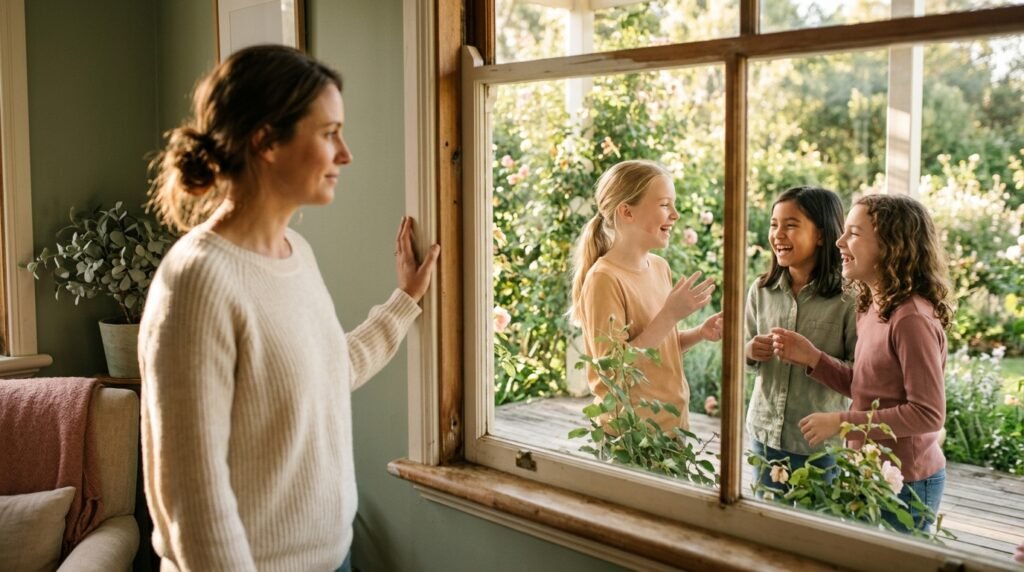
When your daughter prefers her friends over you, something quietly shifts between you.
You used to be her favorite person.
Weekend plans meant doing something together. When something exciting happened, you were the first person she wanted to tell. When something went wrong, she came straight to you.
And then, somewhere around 10 or 11 or 12, something shifted.
Now her friends are everything. Plans with you get cancelled for plans with them. Good news gets texted to her group chat before it ever reaches you. And when something goes wrong — you find out days later, if at all.
It’s one of the more quietly painful parts of parenting a preteen. And almost nobody talks about it honestly.
So let’s talk about it.
FIRST — THIS IS SUPPOSED TO HAPPEN
It doesn’t feel like it. It feels like loss. But what you’re watching is actually healthy development unfolding exactly as it should.
During puberty, a fundamental shift occurs in how young people orient themselves socially. In childhood, parents are the primary attachment figures — the ones children turn to for comfort, validation, and belonging.
In adolescence, that orientation begins to shift toward peers.
This isn’t rejection. It’s biology. It’s the brain’s way of preparing a young person to eventually leave the family of origin and build their own life — connected to people they’ve chosen, not just people they were born to.
Her friends are becoming her people. And that’s a sign she’s developing exactly as she should.
Knowing this doesn’t make it hurt less. But it might make it feel a little less personal.
WHAT SHE’S ACTUALLY LOOKING FOR IN HER FRIENDS
To understand the shift, it helps to understand what her friendships are giving her that feels new and necessary.
A sense of identity separate from you. With her friends, she gets to be just herself — not someone’s daughter. She can experiment with who she is outside of the family context.
Peer validation. At this age, being understood by someone your own age feels different — and in some ways more powerful — than being understood by a parent. It’s not that your love means less. It’s that their understanding of her specific experience feels more immediate.
A safe place to make mistakes. With friends, she can try things out, say the wrong thing, recover, and move on — without the stakes feeling quite as high as they do at home.
Social practice. Friendship at this age is genuinely demanding. It requires negotiation, vulnerability, conflict resolution, loyalty. She is learning skills she will use for the rest of her life.
She’s not replacing you. She’s building a life. And her friends are part of what that life needs right now.
THE THINGS THAT MAKE IT HARDER
Some parents handle this shift relatively smoothly. Others find it genuinely destabilizing. Often the difference comes down to a few specific patterns.
Taking it personally. When you interpret her preference for friends as a statement about you — your worth, your relationship, whether she loves you — it makes every interaction feel loaded. She senses it. It adds pressure to something that should be neutral.
Competing with her friends. Trying to be her best friend, keeping score of how much time she spends where, expressing hurt when she chooses them — this puts her in an impossible position. She shouldn’t have to manage your feelings about her growing up.
Restricting her friendships. Limiting her access to friends out of your own discomfort is one of the fastest ways to damage trust and create distance. She will resent it — and she will find ways around it.
Over-interpreting normal distance. Not every quiet evening means something is wrong. Not every “I don’t want to talk about it” is a red flag. Some distance is just distance — the ordinary space of a person becoming themselves.
WHAT ACTUALLY KEEPS YOU CLOSE
Here’s the counterintuitive truth: the parents who stay closest to their daughters during this period are usually the ones who push the least.
They create connection without requiring it. They stay present without hovering. They let her come — and when she does, they make it worth it.
Be interested in her world — not just her whereabouts.
“How’s Zoe doing?” lands differently than “where were you and who were you with?” One opens a door. The other closes one.
Make home feel easy.
If coming home means interrogation, tension, or walking on eggshells — she’ll avoid it. If coming home means warmth, low pressure, and someone who’s genuinely glad to see her — she’ll come back.
Find the activities she still wants to share.
Most girls — even the ones who seem most pulled away — still have things they enjoy doing with their mothers. A show they watch together. A restaurant they love. A Saturday morning routine. These don’t have to be elaborate. They just have to be consistent.
Let her friends be welcome.
If you genuinely like her friends — or at least make the effort to know them — you’re part of her social world rather than separate from it. Opening your home to her friends is one of the most effective things you can do to stay connected during this season.
Say less. Listen more.
When she does talk, the worst thing you can do is jump in with advice, judgment, or your own experience. Just listen. Ask one question. Let her lead.
She’ll remember that you were someone she could talk to. And she’ll come back.
WHAT TO DO WHEN IT HURTS
Because sometimes it just does. And that’s allowed.
Watching your daughter turn toward her friends and away from you is a particular kind of grief — one that doesn’t have a name, that you can’t fully explain to people who aren’t in it, and that nobody prepares you for.
Let yourself feel it. Not in front of her — she doesn’t need to carry that. But with a friend, a partner, a journal, a therapist. The grief of your child growing up is real, and it deserves acknowledgment.
What helps: remembering that this is not the end of your relationship. It’s a transition. The closeness you built in the early years is not gone — it’s stored. She’s carrying it with her, even when she’s not with you.
And the relationship you’re building now — one that respects her autonomy, trusts her development, and stays steady through the distance — is the foundation of the relationship you’ll have with her as an adult.
That relationship is worth being patient for.
WHEN TO BE CONCERNED
Most of what looks like “preferring friends over parents” is developmentally normal. But there are situations worth paying closer attention to:
If she seems to have no friends at all, or is socially isolated — that’s worth addressing, as social connection is essential to wellbeing at this age.
If her friendships involve behavior that concerns you — if something feels off about how she’s being treated, or if the group dynamic seems harmful — trust your instincts and find a gentle way to open a conversation.
If the pulling away is accompanied by significant mood changes, withdrawal from all activities, or other signs of depression or anxiety — it may be more than typical adolescent distance. Speaking with a pediatrician or school counselor is worth considering.
And if she tells you something directly — even something hard — that’s a gift. Respond to it like one.
YOU’RE STILL HER MOM
On the hardest days, it’s worth remembering this.
You are still the person she came from. The person she’ll call when something is really wrong. The person whose opinion — even when she pretends otherwise — still matters more to her than almost anyone else’s.
She’s not leaving you. She’s just growing up.
And she needs you to be okay with that — so she can grow up without guilt, without worry, without the feeling that becoming herself is somehow a betrayal.
Give her that. And she’ll find her way back to you.
She always does.
WANT HELP NAVIGATING THIS SEASON?
The free Parent Conversation Guide includes practical language for staying connected with your daughter through puberty — including how to keep the door open when she seems like she’s pulling it shut.
Download it free below.
AND FOR HER
Gentle First Period gives your daughter a space of her own — warm, honest, written like an older sister. A book she can read privately, at her own pace, that meets her exactly where she is.
Available on Amazon.
SHE’S STILL YOURS
The girl who chose her friends today will call you tomorrow.
Maybe not tomorrow literally. But she will call. She will come home. She will sit on your bed and tell you things — when she’s ready, in her own time.
Keep the light on. Keep the door open. Keep showing up.
That’s all she needs from you right now.
That, and knowing you’re not going anywhere.