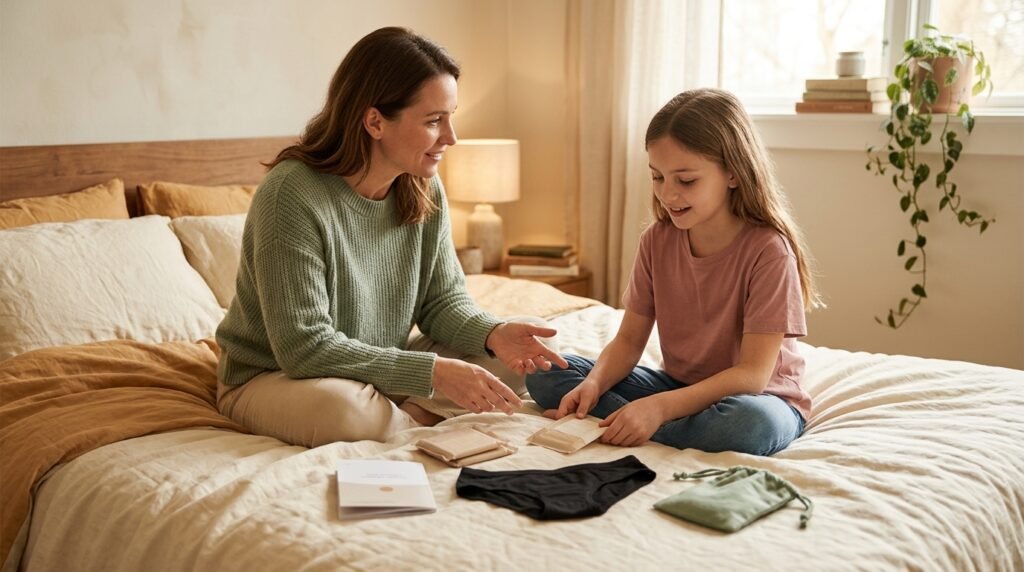
When it comes to period products for girls, she started with pads. That was the right call.
Pads are simple, visible, and require no new learning — which is exactly what a girl needs when she’s managing her first period and there’s already plenty to navigate.
But at some point — maybe when swim season comes around, or when she mentions that she finds pads uncomfortable, or when she simply asks what else is out there — the conversation expands.
There are more options than most girls know about. And knowing about them — without pressure, without a timeline — gives her something valuable: choice.
Here’s how to walk her through it.
Period Products for Girls — Why Options Matter
For generations, pads and tampons were essentially the only options available. The conversation was limited because the choices were limited.
That’s changed significantly. Today’s girls have access to a wider range of period products than any previous generation — and understanding what exists, and what each one actually involves, means she can find what works for her body and her life rather than defaulting to whatever’s in the bathroom cabinet.
The goal of this conversation isn’t to push her toward any particular product. It’s to make sure she knows what’s available — so that when she’s ready to explore, she has accurate information rather than guesswork or myths.
PADS — WHERE MOST GIRLS START
Pads are the simplest and most intuitive option for a first period, and there’s no reason to move away from them unless she wants to.
They come in a wide range of sizes — thin panty liners for lighter days, thicker pads for heavier flow, overnight versions for sleeping. Teaching her to match the pad to her flow — rather than using one type for everything — is a small practical lesson that makes a real difference in comfort and confidence.
The main limitations of pads are the ones she’ll likely discover on her own: they don’t work for swimming, some girls find them uncomfortable in heat or during exercise, and they require access to a bin for disposal. None of these are problems — they’re just realities that might eventually prompt her to explore alternatives.
TAMPONS — THE BASICS, WITHOUT THE MYTHS
Tampons are the product surrounded by the most myths — and the most unnecessary anxiety. Getting accurate information to your daughter early means she doesn’t have to sort through misinformation later.
What they actually are.
A tampon is a small, compact cylinder of absorbent material that’s inserted into the vagina to absorb flow internally. It comes with either a cardboard or plastic applicator to make insertion easier, or without one.
The myth that needs clearing up.
Using a tampon does not affect virginity. It cannot get lost inside the body. It has a removal cord that stays outside. These are the three things most girls worry about — and none of them are true concerns.
When she might want to start.
There’s no age requirement or milestone that determines when tampons are appropriate. Many girls start using them when swimming becomes relevant. Others prefer them for sport generally. Some don’t switch until their late teens or never do. All of these are fine.
How to introduce it.
If she’s curious, the best approach is a calm walkthrough — ideally with the product in hand — of how it works. Many girls find their first attempt easier than expected once the mystery is removed. Some find they need a few tries. Patience, no pressure, and the reminder that she can always go back to pads is all she needs.
MENSTRUAL CUPS — WORTH KNOWING ABOUT
Menstrual cups are small, flexible cups — usually made of medical-grade silicone — that are inserted to collect flow rather than absorb it. They’re reusable, can typically be worn for up to twelve hours according to Mayo Clinic, and produce no waste.”
For younger girls, cups are usually not the first choice — they require a bit more learning and comfort with one’s body than pads or tampons. But they’re worth mentioning as an option that exists, especially for girls who are interested in sustainability or who spend long stretches in situations where changing isn’t practical. Understanding period products for girls means clearing up the myths early.
The conversation doesn’t need to be detailed at this stage. “There’s also something called a menstrual cup, which is reusable and lasts for years — it’s something some people switch to later on” is enough. She has the name. She can ask more when she’s interested.
PERIOD UNDERWEAR — THE ONE THAT SURPRISES MOST GIRLS
Period underwear looks and feels like regular underwear, but has built-in absorbent layers that work like a very thin pad. It can be worn alone on lighter days, or as a backup layer on heavier ones.
Most girls are genuinely surprised this exists — and once they know about it, many find it appealing for overnight use, for lighter days, or for the days leading up to their period when they’re not sure if it’s starting.
It’s reusable, comfortable, and removes the need to carry products. The main thing to know is that it needs to be rinsed and washed after use — which is a simple habit once it’s established.
Introducing period underwear — even just leaving a pair on her bed with a brief explanation — can feel like a gift. It’s one less thing to manage, and it gives her an option that feels like any other piece of clothing.
HOW TO HAVE THIS CONVERSATION
You don’t need to cover all of this in one sitting. In fact, it’s better if you don’t.
The most natural approach is to introduce options as they become relevant — starting with pads when her period begins, mentioning tampons when swimming or sport comes up, bringing up period underwear when she seems comfortable with the basics.
What you want to avoid is either extreme: giving her so little information that she thinks pads are the only option, or overwhelming her with a product catalogue before she’s even had her first period.
A useful frame: “There are a few different options for managing your period — pads are what most girls start with, but there are others you can try when you’re ready. We can go through them whenever you’re curious.”
That one sentence tells her the world is bigger than she might think — and that you’re available to navigate it with her.
THE ROLE OF CHOICE
Here’s what getting this conversation right actually gives your daughter.
It gives her agency over her own body. The ability to choose — to try something, decide it’s not for her, try something else — is something most women didn’t have in the same way at her age. And agency, in something this personal, builds confidence that extends beyond period products.
She learns that her body is something she gets to understand and manage on her own terms. That there isn’t one right answer. That she gets to figure out what works for her.
That’s a bigger gift than any specific product recommendation.
WANT HELP WITH THESE CONVERSATIONS?
The free Parent Conversation Guide includes practical language for talking to your daughter about period products — and all the other practical questions that come up when her body starts changing.
AND FOR HER
Gentle First Period walks your daughter through her period product options in language that’s honest, practical, and completely non-intimidating. Including how to use a pad step by step — and what else exists when she’s ready to explore.
Available on Amazon.
HER BODY, HER CHOICE
Helping her understand period products for girls now means she’ll feel confident making her own choices later. There’s no perfect product. There’s just the one that works for her — in this season, for this body, for this life.
Help her know what’s out there. Let her find her own way to it.
That’s all she needs from you on this one.