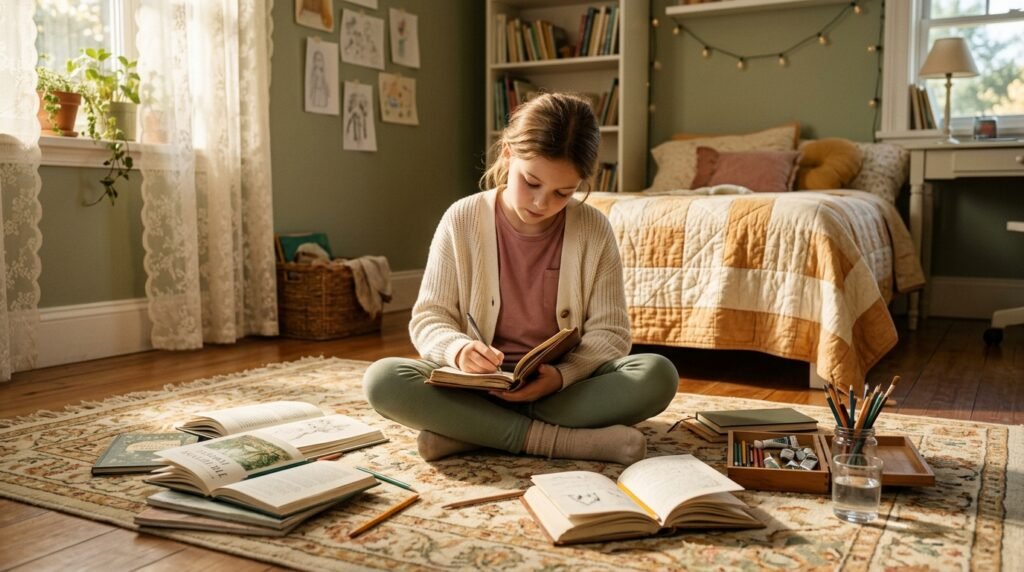
She’s not going to sit down for a puberty lecture.
Not tonight. Not when her favourite show is on, her friends are texting, or she’d simply rather be doing anything else.
And that’s completely fine — because the best learning doesn’t always look like learning. It looks like a conversation that happens while you’re cooking dinner. A journal entry written before bed. A walk where something important gets said without anyone planning it.
The activities below are designed for girls aged 8 to 12 — some for the younger end, some for older tweens, and some that work beautifully for both. None of them require a formal sit-down. All of them open doors.
1. READ TOGETHER
Books do a lot of the explaining so you don’t have to. They give her words for things she’s noticed but couldn’t name, and they make it easier to ask questions — because the question can be about the book, not about herself.
Ages 8-10 — Choose Her Book
Find a warm, illustrated puberty guide written for younger girls — something that looks inviting rather than clinical. Leave it on her nightstand without pressure. The simple act of having it there sends a message: this is something we can talk about.
Try this: Ask her after a few days: ‘Was there anything in there that surprised you?’ You don’t need to have all the answers. Just being curious together is enough.
Ages 10-12 — Read the Same Book
Choose a book you’ll both read — perhaps a puberty guide for girls or a novel with a protagonist going through something similar. Reading separately and then talking about it creates a low-pressure entry point for bigger conversations.
Try this: After you’ve both read a chapter, ask: ‘What was the most relatable part for you?’ Let her lead. You’re just there to listen.
Any age — Library Trip
A trip to the library or bookshop where she gets to choose her own book about growing up gives her agency. She’s more likely to read something she picked herself — and what she gravitates toward tells you something about what she’s curious about.
Try this: Browse together without directing. Let her take her time. The browsing itself is part of the conversation.
2. JOURNAL TIME
A journal gives her something that’s hard to find during puberty: a private space that belongs entirely to her. She can write what she’s feeling without having to explain it to anyone.
Ages 8-10 — My Feelings Journal
Give her a beautiful notebook and a simple starting point: one question per day. ‘How do I feel today?’ ‘What made me smile?’ ‘What felt hard?’ At this age, the habit of checking in with herself is more important than what she writes.
Try this: Leave the notebook somewhere private — her desk, her drawer. No reading without permission. The safety of the space is everything.
Ages 10-12 — Mood and Cycle Tracker
An older girl might enjoy tracking her moods over weeks or months. She’ll start to notice patterns — days when she feels energetic, days when she feels low, how this might connect to her cycle. This kind of self-knowledge is genuinely powerful.
Try this: Create a simple colour-coded system together: one colour for each mood. At the end of a month, look at the page together. ‘What patterns do you notice?’
Any age — Letter to Future Self
Ask her to write a letter to herself to be opened in one year. What does she hope will have changed? What does she want to remember about right now? This exercise builds perspective and gives her a relationship with her own story.
Try this: Seal the letter together, write the opening date on the envelope, and put it somewhere safe. When the date arrives, read it together if she wants — or let her read it alone.
3. GET CREATIVE
Creativity is how many girls process things they can’t yet say in words. Drawing, making, building — these activate a different part of the brain and often unlock feelings that stay stuck in more direct conversations.
Ages 8-10 — My Body Belongs to Me Collage
Gather magazines, coloured paper, stickers and glue. Ask her to create a collage that shows things she loves about herself — her strengths, her favourite things, her personality. This is about building a positive relationship with who she is, not just how she looks.
Try this: Make your own collage at the same time. Talk about what you chose. Let her see you valuing yourself.
Ages 10-12 — How I Feel Today Art
Give her a blank page and art supplies and a single prompt: ‘Make something that shows how you feel right now.’ No further instructions. Whatever comes out is right. Over time, this builds emotional vocabulary she can draw on when words feel hard.
Try this: Do this regularly — weekly, or whenever things feel tense. It doesn’t need to be discussed. Just making is enough.
Any age — Playlist for Every Mood
Ask her to create playlists for different emotions — one for when she’s happy, one for when she’s overwhelmed, one for when she needs to feel brave. Music is one of the most immediate emotional regulation tools available to her, and building this library gives her something to reach for.
Try this: Ask her to share one playlist with you. Listen to it together on a car ride. You’ll learn a lot about her inner world without asking a single direct question.
4. MOVE & MINDFUL
Her body is changing fast. One of the most powerful things she can learn is how to feel at home in it — not when it’s ‘done changing,’ but right now. Gentle movement and mindfulness help her feel connected to her body rather than at odds with it.
Ages 8-10 — Breathing Buddy
Teach her the 4-4-4-4 breathing technique: breathe in for 4, hold for 4, breathe out for 4, hold for 4. Practice it together when things are calm so it’s available when things aren’t. At this age, having a physical tool she can use anywhere is enormously reassuring.
Try this: Name it together — ‘our breathing trick,’ ‘the calm-down breath,’ whatever feels natural. Having a name makes it easier to reach for in the moment.
Ages 10-12 — Yoga for Hard Days
Look up a simple yoga sequence together — something short, 10 to 15 minutes. Child’s pose, cat-cow, legs up the wall. These poses genuinely help with cramps and with the feeling of being overwhelmed. Practising them when she’s not in pain means she’ll remember them when she is.
Try this: Do it with her the first time. You don’t have to be a yoga expert. Just being willing to try alongside her is what matters.
Any age — The Walk Where Things Get Said
Walk side by side without a destination. No phones. No agenda. Something about moving in the same direction — not facing each other — makes certain conversations much easier. Some of the most important things get said on ordinary walks.
Try this: Don’t fill the silence. Let it be comfortable. If she starts talking, listen more than you speak. The walk itself is doing the work.
5. PLAY & LEARN
Not everything needs to feel serious. Some of the best learning happens when nobody feels like they’re being taught anything — when they’re having too much fun to notice.
Ages 8-10 — Myth or Fact Card Game
Write puberty myths and facts on separate index cards and take turns drawing them. ‘True or false: you can’t exercise during your period.’ ‘True or false: everyone develops at the same pace.’ Keep it light — let her be right sometimes, let her be surprised. Learning through laughter sticks.
Try this: Make the cards together before you play. The making is part of the learning — she’ll absorb the content while you write it out.
Ages 10-12 — Period Kit Challenge
Give her a small budget and challenge her to build the perfect Period Kit — visiting the pharmacy together, choosing what goes in. She gets to make decisions, understand the options, and own the result. The kit becomes hers in a way that a pre-packed one never would.
Try this: Step back and let her lead. Your job is to answer questions, not to direct. Whatever she builds is right.
Any age — Quiz Night for Two
Create a simple quiz together — you ask questions, she answers, then swap. Questions can be about puberty basics, but also about feelings, what helps, what she’d do in different situations. Frame it as a game, not a test. End with something fun.
Try this: Let her make up her own questions for the quiz. What she asks tells you exactly what she’s thinking about.
6. REAL LIFE PRACTICE
The most durable learning is the kind that happens in real situations. Not talking about what she might do — actually doing it, or a version of it, in a safe context.
Ages 8-10 — What Would You Do?
Walk through simple scenarios together: ‘What would you do if your period started at school?’ ‘What would you say to the nurse?’ ‘Who would you text?’ Not as a test — as a conversation. At this age, just knowing there’s a plan is enormously calming.
Try this: After she answers, say: ‘That’s a really good plan.’ Reinforce her confidence in her own thinking.
Ages 10-12 — Practise the Sentence
Give her one sentence she can use in any situation where she needs help: ‘I think I just got my period. Can you help me?’ Practise saying it out loud together until it feels ordinary. When the moment comes — wherever she is — she won’t have to find the words. She’ll already have them.
Try this: Say it yourself first. ‘If I were you, I’d say something like this.’ Then let her try. The more times she says it, the more available it becomes.
Any age — Her Emergency Kit, Her Way
Build her Period Kit together, but let every decision be hers. Which pouch. Which pads. What else goes in. Where she’ll keep it at school, what she’ll keep at home. The ownership of those decisions builds confidence that no amount of information can replace.
Try this: After it’s built, ask: ‘Is there anything you’d want to add or change?’ Check in every few months. Her needs will evolve as she does.
THE THING ALL SIX HAVE IN COMMON
None of these activities require a formal conversation about puberty.
They create the conditions for learning to happen — quietly, at her pace, in ways that feel natural rather than forced. And they tell her something important without anyone saying it out loud:
You are not alone in this. The people who love you are paying attention.
That might be the most important thing she learns.
WANT MORE SUPPORT?
The free Puberty Workbook for Girls gives your daughter her own space to explore, reflect and build confidence — with activities she can do at her own pace, in her own way.
And for a warm, beautifully illustrated guide she can read alongside all of these activities — Gentle Puberty is available on Amazon.