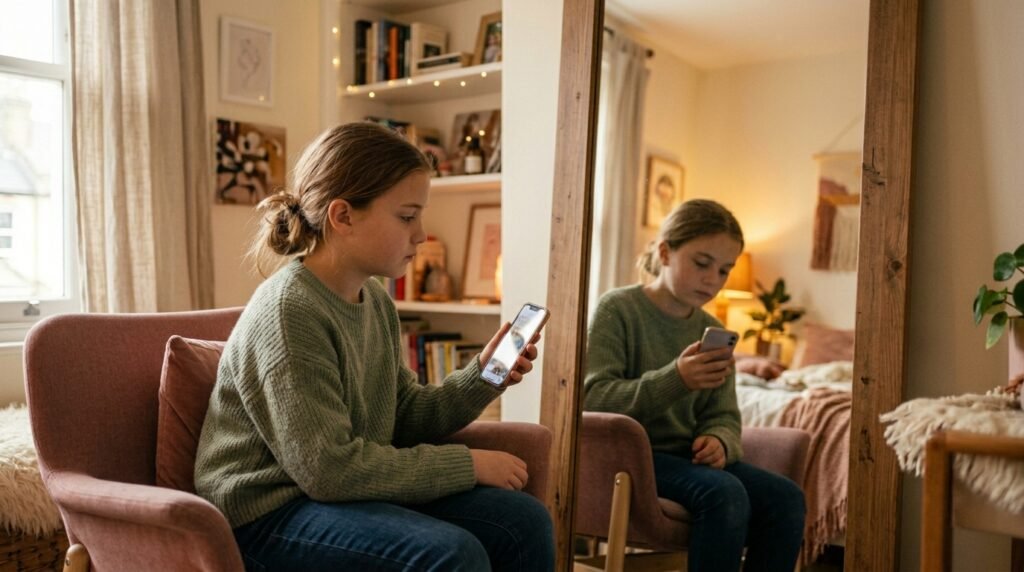
How social media affects daughter body image is something more parents are asking as screens become impossible to avoid.
She’s been on her phone a lot lately.
More than usual. Scrolling quietly. Sometimes you catch her looking at something and then putting the phone face-down when she hears you coming. She’s not doing anything wrong — but something about the way she holds herself after a long scroll session is different from before she started.
A little quieter. A little more critical when she passes a mirror. A little quicker to say she doesn’t want to go somewhere because she doesn’t “look right.”
You’re not imagining it. Something is happening. And understanding what it is — and what you can actually do about it — is where this conversation starts.
WHAT SOCIAL MEDIA DOES TO A DEVELOPING BRAIN
Social media wasn’t designed for preteen girls. It was designed for engagement — and it achieves that engagement, in part, by activating the parts of the brain most sensitive to social comparison and approval.
For a girl in the middle of puberty — already hyperaware of her body, already measuring herself against peers, already navigating significant uncertainty about who she is and how she fits — that combination is particularly potent.
The research is consistent: girls who spend significant time on image-focused social platforms during puberty report lower body satisfaction, higher rates of comparison, and greater susceptibility to the idea that their bodies need to be fixed, filtered, or improved. This isn’t a character flaw. It’s a predictable response to an environment specifically engineered to produce it.
Knowing this doesn’t require panic. But it does require paying attention.
WHAT SHE’S ACTUALLY SEEING
It’s worth being specific about what your daughter encounters when she scrolls — because it’s often not what parents imagine.
It’s not necessarily explicit content or obvious danger. It’s subtler than that. It’s a feed full of images where bodies have been carefully lit, posed, filtered, and edited — presented as ordinary life. It’s comment sections where girls evaluate each other’s appearances in casual, throwaway language. It’s algorithms that learn what holds her attention and serve her more of it — which, for many girls, means more comparison content, more idealized bodies, more implicit messages about what she should look like.
She’s absorbing this for minutes, sometimes hours, every day. And unlike a single conversation or a single comment, the accumulation is what does the damage — the slow, repeated exposure to a version of reality that doesn’t look anything like her actual mirror.
THE SIGNS WORTH WATCHING FOR
Not every girl is significantly affected by social media in the same way. But there are signs that the impact is becoming meaningful.
She talks about her body more negatively after time on her phone.
This doesn’t have to be dramatic. It might just be a comment about her stomach, or her skin, or her hair — said in a tone that wasn’t there before. Patterns matter more than single incidents.
She’s comparing herself to people she follows.
“She’s so much prettier than me.” “I wish I looked like her.” If she’s named someone she follows and the tone is wistful or self-critical — that’s worth noting.
She’s editing or filtering her own photos heavily before sharing.
Some engagement with filters is normal. But significant anxiety about how she looks in an unedited photo, or reluctance to be photographed at all, can be a signal.
She avoids situations because of how she looks.
Declining to go to the pool. Refusing to be in family photos. Choosing not to join something because she’s worried about what she looks like doing it. When appearance anxiety starts limiting her life, it’s worth addressing directly.
WHAT DOESN’T WORK
When you start researching how social media affects daughter body image, you’ll find two approaches that feel intuitive but tend to backfire.
Taking away her phone or banning social media.
This can work as a short-term reset and may be appropriate in some circumstances. But as a long-term strategy, it often increases the appeal of what’s been forbidden and removes your visibility into what she’s experiencing. It also doesn’t address the underlying vulnerability — which will still be there whenever she regains access.
Telling her the images are fake.
She knows this, intellectually. Telling her that the images are filtered and edited doesn’t change how they make her feel. Cognitive knowledge and emotional experience operate on different tracks. “It’s not real” rarely soothes a feeling that is already real.
WHAT ACTUALLY HELPS
Have the conversation — but make it curious, not critical.
“I’ve been thinking about how much time I spend on social media and how it makes me feel about myself. Do you ever notice that it affects your mood?” This approach opens a door without putting her on the defensive. You’re sharing your own experience, not diagnosing hers.
Help her develop her own media literacy — gradually.
Not a lecture on algorithms and image manipulation, but small observations over time. “That photo looks really edited — her skin doesn’t have any texture.” “I wonder how many photos they took before they got that one.” Over months, these small observations build a more critical eye without requiring a formal lesson.
Build identity outside the screen.
The girls who seem most resilient to the effects of social media are the ones with strong identities built on things other than appearance — a sport they love, a creative skill, a tight group of real-world friends. These aren’t a shield, but they provide perspective. The phone becomes one part of her life, not the primary mirror she holds up to herself.
Model what you want her to absorb.
How you talk about your own body. Whether you put your phone down when you’re together. How you respond when you see an idealized image. She is watching all of it — and your relationship with your own appearance and your own screen is more influential than almost anything you say.
Keep the lines open.
The goal isn’t to remove social media from her life — it’s to make sure she can talk to you about what she’s seeing and how it makes her feel. If she knows she can say “this account makes me feel bad about myself” and you’ll take it seriously without overreacting, she’ll keep talking. And that conversation, ongoing, is your most important tool.
A NOTE ON TIMING
Puberty is the window when this matters most. The combination of a body that’s changing rapidly, a brain that’s wiring itself partly around social feedback, and a daily feed of idealized images is genuinely risky in a way that’s different from social media use at other ages.
You don’t have to fix everything. You just have to stay present, stay curious, and keep the conversation going.
That’s enough. It really is.
WANT HELP WITH THESE CONVERSATIONS?
The free Parent Conversation Guide includes practical language for talking to your daughter about the things that shape how she sees herself — including the conversations that happen on and off screen.
AND FOR HER
Gentle Puberty talks to your daughter directly about her changing body — in language that is warm, honest, and entirely free of the filtered version of reality she sees online. Something real, in her hands, that she can come back to.
Available on Amazon.
THE REAL MIRROR
Social media will keep showing her a version of the world that isn’t true. You can’t change that.
But you can be a different kind of mirror. One that shows her something accurate — and kind. One that reflects back who she actually is, not who an algorithm thinks she should want to be.
That mirror is you. And she needs it more than she’ll ever say.