Growing up is more than getting her first period — though it’s often the thing parents think about most.
Maybe you’ve already bought pads. Maybe you’ve explained what will happen. Maybe you’ve even tucked a small period kit into her backpack, just in case.
And that’s important.
Knowing what a period is — and knowing what to do when it arrives — can take a lot of fear out of that first experience.
But somewhere between preparing her for that first period and watching her grow up, something becomes clear.
The physical changes are only part of it.
The Changes You Can’t Put on a Checklist
Puberty is easy to describe as a list.
Breasts develop. Body hair appears. Skin changes. Periods begin.
Those things matter, and girls deserve clear, honest information about all of them. But the changes that are hardest to prepare for often don’t fit neatly on a puberty timeline.
She may suddenly care much more about what a friend thinks of her. A comment that would have rolled off her a year ago might stay with her all afternoon. She may want more privacy and still want you nearby. She may feel confident one day and deeply unsure of herself the next.
None of this comes with a predictable start date.
Growing up happens in dozens of small moments — in the bathroom mirror, at lunch with friends, on the walk home from school, in the quiet few minutes before bed.
She’s Learning to Notice Her Body
Before a girl can feel comfortable in a changing body, she has to learn how to notice it without immediately judging it.
That includes the obvious things, like recognizing period signs or understanding why her chest is changing. But it also includes quieter signals: feeling tired, tense, hungry, restless, uncomfortable, or simply different from usual.
Girls don’t always have language for those signals yet.
Sometimes “I’m fine” really means she doesn’t know what she’s feeling. Sometimes irritability is exhaustion. Sometimes a stomachache arrives before a difficult school day. Sometimes she just needs more space than she did before.
Helping her notice patterns gives her something more useful than a list of puberty facts. It helps her begin to understand herself.
Her Feelings Are Changing Too
One of the confusing things about puberty is that a girl can know something is small and still feel it very deeply.
A friendship wobble can feel enormous. Embarrassment can linger. Anger can arrive quickly. Tears can show up before she has figured out what she’s upset about.
The goal isn’t to teach her to control every feeling or explain every mood.
It’s to help her recognize that feelings carry information — and that she doesn’t have to be afraid of them.
When she can pause long enough to notice “I’m disappointed,” “I feel left out,” or “I need some time alone,” she has more choices about what to do next.
That skill will matter long after her first period has become ordinary.
Friendships Start to Feel Different
For many girls, growing up changes friendships almost as much as it changes bodies.
Groups shift. Best friends become less predictable. New friendships form. Someone gets left out. Someone shares something that was supposed to stay private. A girl who once said exactly what she thought may suddenly worry about saying the wrong thing.
This is where boundaries begin to matter in a very real way.
Can she say no without feeling mean? Can she recognize when a joke doesn’t feel funny anymore? Does she know that being a good friend doesn’t require agreeing to everything? Can she tell the difference between privacy and keeping a secret that makes her uncomfortable?
These aren’t side topics to puberty. They’re part of growing up.
Confidence Doesn’t Arrive All at Once
Parents sometimes imagine confidence as something a girl either has or doesn’t.
At this age, it’s usually much less tidy.
She can feel completely sure of herself while drawing, playing soccer, or talking with one friend — and then shrink into herself when she walks into a room full of girls she doesn’t know well.
She can like her body in the morning and compare it to someone else’s that afternoon.
Confidence during puberty is built in small repetitions: noticing what she likes, making choices, recovering from awkward moments, speaking up, changing her mind, trying again.
She doesn’t need to feel fearless. She needs enough trust in herself to keep going when she doesn’t.
What Actually Helps
Give her information — and somewhere to process it.
Knowing what happens during puberty matters. But girls also need room to work out what those changes mean for them personally. A question, a checklist, a tracker, or a small creative activity can sometimes make that easier than a direct conversation.
Let privacy be part of the process.
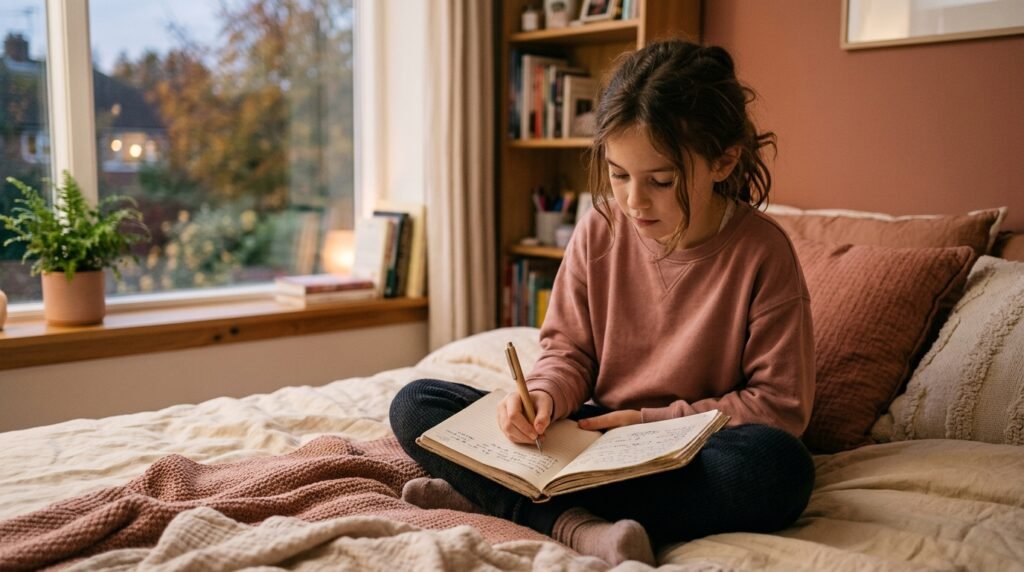
Not everything she thinks needs to become a family discussion. As she grows, having thoughts that belong only to her is healthy. A private place to write, check a box, color something in, or simply notice a pattern can help her build independence without feeling alone.
Keep conversations available instead of forcing them.
You don’t have to turn every mood or friendship problem into a lesson. Sometimes the most useful thing you can say is, “I’m here if you want to talk about it.” Then let the door stay open.
Notice the whole girl.
Her period matters. Her changing body matters. So do the friendship she can’t stop thinking about, the boundary she’s trying to set, the thing she’s suddenly proud of, and the version of herself she’s beginning to discover.
Growing up is all of it.
And for Her
The Gentle Growth Companion was created for that part of growing up that doesn’t fit into a single conversation — or a single period tracker.
It’s a private guided journal for girls ages 8–12, with activities and tools that help her track personal patterns, notice body signals and feelings, explore friendships and boundaries, and build confidence at her own pace.
She can write. Check a box. Color. Track. Reflect. Or leave a page and come back to it later.
There are no right answers, and she doesn’t have to share what she writes.
Because growing up doesn’t follow a schedule.
Available on Amazon
The Part That’s Easy to Miss
Preparing your daughter for her first period is one of the practical things you can do for her.
But she is preparing for much more than a period.
She’s learning how to live in a changing body. How to understand feelings that don’t always make sense yet. How to choose friends, protect her boundaries, trust her own voice, and become more herself.
She won’t learn all of that at once.
She doesn’t need to.
She just needs enough information, enough space, and enough steady support to keep finding her way.
And sometimes, the most important part of helping her grow is remembering to look beyond the milestones — and notice the girl growing through them.