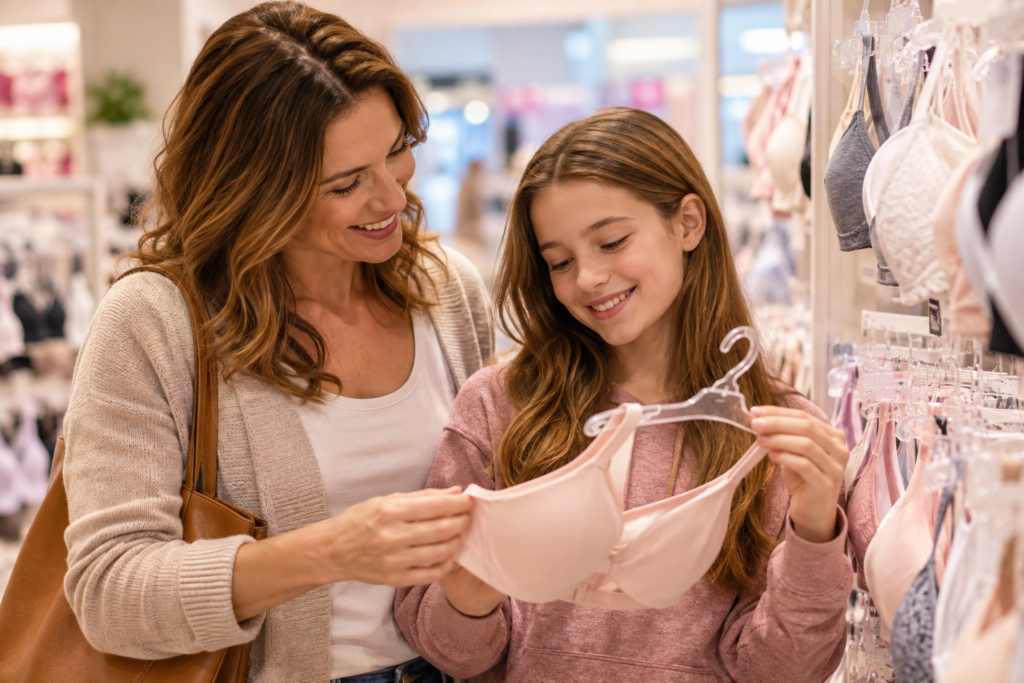
She mentioned it offhandedly.
Or she didn’t mention it at all — but you noticed. The way she holds her arms when she runs. The fact that she’s started wearing looser tops. A certain self-consciousness that wasn’t there six months ago.
She might be ready for a bra — or simply something that gives her a little more coverage or support. And she may already know it, even if she hasn’t said anything, because she’s not sure how to bring it up or whether you’ll make it a bigger deal than she wants it to be.
This is one of those moments that can go smoothly or awkwardly — and the difference is often in how you approach it. Here’s how to make the first bra conversation feel practical, private, and low-pressure.
WHEN TO BRING IT UP
There isn’t one exact moment when a girl “needs” her first bra. The right time is usually when a little extra coverage or support would help her feel more comfortable — physically or emotionally.
If you’ve noticed breast development beginning, she’s adjusting her clothes more often, covering her chest, asking for more privacy, or seeming uncomfortable during sports, it may be worth gently opening the conversation.
You don’t have to wait for her to ask. For many girls, bringing it up themselves feels embarrassing even when they would welcome the option.
A quiet, private moment is ideal. Not at the dinner table. Not in front of siblings or other family members. Just the two of you, in passing or during a calm moment at home.
The tone matters as much as the words. If you sound matter-of-fact — like this is a completely normal thing to talk about, which it is — she can take her cue from you. If you treat it like a major milestone before she does, the conversation may suddenly feel much bigger than she wanted it to.
WHAT TO ACTUALLY SAY
Keep it simple. Keep it practical. Keep it about her comfort, not the milestone.
“I noticed you might be ready for something that gives you a little more coverage or support. Do you want to look at some options together?”
That’s it. No ceremony. No “this is a big moment” energy unless she brings that herself. Just: I noticed, I want to help you feel comfortable, and you get a say in what happens next.
She might say yes immediately. She might shrug and say she doesn’t care. She might seem embarrassed and change the subject. All of these are possible responses. The important thing is that you opened the door — and that she knows you’re not going to make it weird.
WHAT SHE ACTUALLY NEEDS — OPTIONS
For many girls at the beginning of breast development, the priority is comfort and coverage rather than structure. There’s no single “right” first bra.
Soft bralettes. Wireless and usually uncomplicated, they can provide light coverage and support without feeling overly structured.
Sports bras. A practical choice for active girls. They can feel familiar and comfortable during sports, gym class, or everyday wear.
Training bras. Usually soft, lightweight options designed for early development. The name may feel a little old-fashioned, but the category can still be useful when shopping.
Wire-free bras. For girls who want a little more support or shape, a soft wire-free bra can offer more structure without jumping straight to underwire.
The goal at this stage is simple: she should feel comfortable enough to forget she’s wearing it. Comfort over everything.
THE SHOPPING TRIP — HOW TO MAKE IT GOOD
The shopping experience itself matters. For many girls, trying on bras for the first time in a fitting room already feels somewhat vulnerable. The last thing she needs is for it to become an event.
Let her lead. She can choose what appeals to her. You’re there for guidance if she wants it — and to make the practical part easy. Her body, her choice, her comfort.
Try a few options. What looks right on a hanger may not feel right once she puts it on. A few different styles can help her notice what actually feels comfortable.
Keep the conversation light. This is not the moment for a deep conversation about puberty or bodies. “Does this feel comfortable?” and “Would you actually wear this?” may be all you need.
Online shopping is an option too. If trying on bras in a store feels uncomfortable, ordering a few simple options to try at home can give her more privacy and less pressure.
WHAT TO DO IF SHE RESISTS
Some girls resist the idea of a bra entirely — and there may be something underneath that resistance worth noticing.
She might feel like getting a bra means acknowledging that her body is changing, and she isn’t ready for that yet. She might worry about what it means socially. She might simply dislike the idea of wearing one.
Unless there’s an immediate comfort issue, you don’t need to turn that resistance into a battle.
“Okay — whenever you’re ready, we can look at some options. No rush.”
Then leave the door open. She may come back to it later. The goal isn’t to move her through a milestone on schedule. It’s to make sure she knows she has support and choices when she wants them.
THE CONVERSATION THAT SURROUNDS IT
The bra itself is just a practical object. But the way you handle the conversation around it tells her something larger: that changes in her body are things you can talk about without embarrassment, pressure, or drama.
That matters because the first bra conversation may be one of the first times you navigate a visible puberty change together.
If it goes calmly — with privacy, practical information, and her comfort at the center — she learns something useful for the next change too: I can come to you. You won’t make it weird. We can figure it out together.
That’s the part that lasts longer than the shopping trip.
WANT HELP WITH THESE CONVERSATIONS?
The free Parent Conversation Guide includes simple, warm language for navigating the practical conversations of puberty — the ones that can feel small but matter more than they seem.
AND FOR HER
Gentle Puberty walks your daughter through the physical and emotional changes of puberty — including body changes, feelings, confidence, and healthy boundaries — in language that is calm, age-appropriate, and reassuring. She can read it privately, at her own pace, and come back to the parts she needs.
Available on Amazon.
JUST A BRA — AND ALSO MORE THAN THAT
It’s a practical object. It’s also a moment.
A moment where you noticed without making it weird. Where you gave her choices instead of pressure. Where you handled a changing body with the kind of calm, ordinary care that tells her: this is something we can navigate together.
She may forget the specific first bra sooner than you expect. But the feeling of being treated with privacy, respect, and warmth can stay much longer.
That part matters.